Queerness, Photography, ect.

  • Who the Hell Was Harry Stratton?

    I am a big fan of niche, odd holidays. 

    Things like the death anniversary of a man who died eating library paste over a century ago, or a day where someone just happened to take a photo of their pet rat playing a miniature keyboard. I think small things like these are genuinely, very important. 

    There is a day like these, which I believe I am the only observer of. 

    Every year on April 15th, I stop and embrace a strange emotion. I’ll have an odd pit in my stomach, and a gentle wave of melancholy will wash over me. 

    It’s difficult to put into words how I feel about this subject now. 

    There was a time when I’d ramble endlessly to whoever would listen to me. There was also a time where I would vehemently dissuade people from thinking on it any further. 

    And now? I’m unsure. 

    I do want to state this;

    You will not be satisfied by this story. 

    It does not have a neat, well rounded ending. 

    That is simply not the point.

    What follows is an edited version of a zine first published in 2022, titled “Who the Hell Was Harry Stratton?”.

    I would like to note that my writing style has changed somewhat in the years since I released this, and the tone might be a bit odd in places.
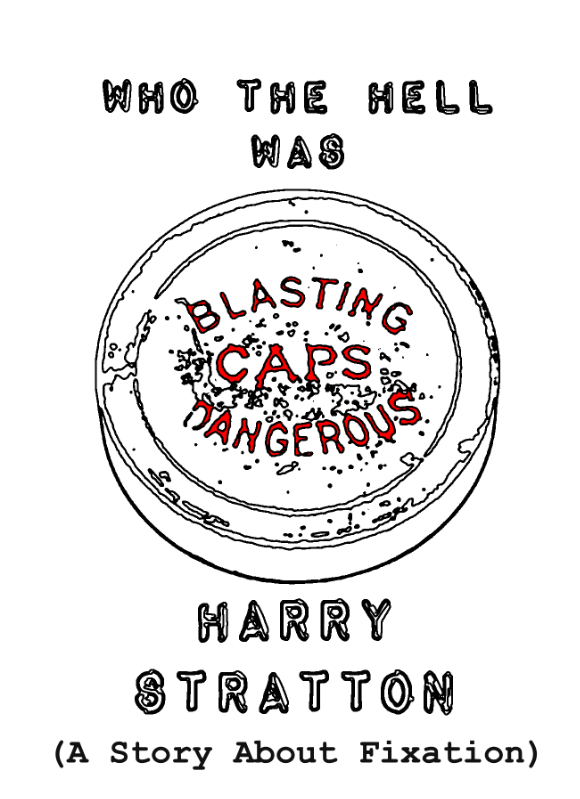

    The original zine’s cover

    April 15th, 1912.

    A mining camp in Crook’s Canyon, AZ.

    The workers for the Champion Gold Mine Co. are preparing for a new day of blasting into the rock of Mt. Union.

    One of the part owners of the company leaves his cot for the morning. He puts on his worn boots, and buttons his work shirt.

    He makes a watery cup of coffee on the cabin stove, and he heads out of the day.

    Mere hours later, the cabin has been decimated. Chunks of the walls are found hundreds of yards away. A cloud of smoke hangs in the air, and the stench of black powder permeates the scene.

    The man, a certain Harry Stratton, lies on the ground, mostly unconscious. His entire body has been penetrated by tiny shards of copper.

    His blood barely begins to pool on the floor before medical attention arrives.

    Mr. Stratton has made one of the most common, deadly mistakes in his line of work; yet, miraculously, he will live to tell the tale.
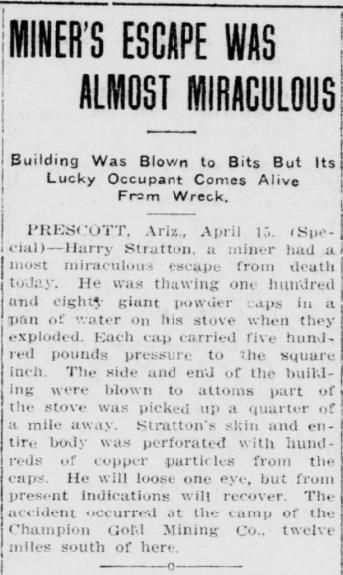
    From the Arizona Republic, April 16th, 1912.

    ———-

    February 3rd, 2019.

    The Burton Barr Library, Phoenix, AZ.

    One of my best friends had recently decided to move to Oregon, so I decided to get our old D&D group back together for one last game.

    Our original sessions had always taken place in the much smaller Juniper Branch Library, but we wanted a more “ceremonial” feeling location, thus, we chose the Burton Barr.

    From what I remember, the game was cut short by some awkwardness between players, likely caused by some old drama. I did what I usually do when situations get uncomfortable, and I left the area.

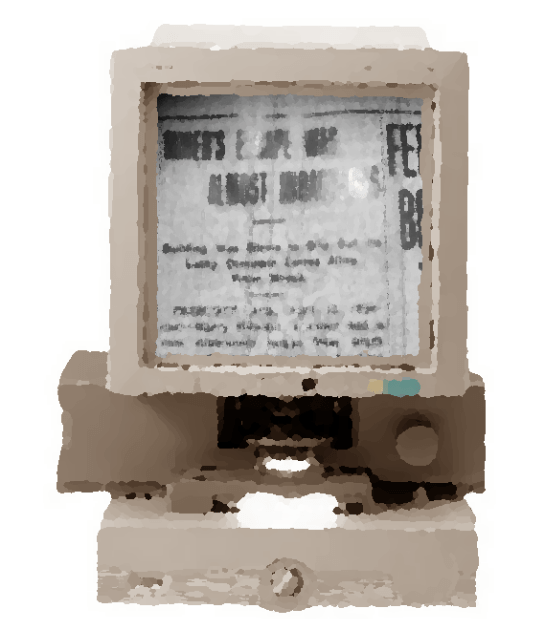
    I went down to the library’s 2nd floor, which was host to a huge selection of historical newspaper microfilm. My favorite video game at the time featured a scene involving a microfilm viewer, so I was eager to try it out.

    The viewer itself was a magnificent piece of late 90’s technology. A giant boxy monitor, which showed a direct projection of the film.

    Bulky gray plastic knobs to control the speed of the film, which had the perfect amount of spring and resistance. Rotating lenses that looked like they belonged on a high school chemistry lab microscope.

    The entire thing was in that beautiful shade of old tech beige.

    (Since then, the Burton Barr has replaced it with a modern, bland, minimalist black metal machine, which has nowhere near the same amount of charm and versatility.)

    I started looking at random stuff, starting with a handful of historic dates I had memorized; JFK & Lincoln’s assassinations, the Apollo 11 moon landing, and the day the Titanic sank.

    On the morning following the Titanic’s fate, a different headline caught my eye. Just under the ship’s article, was one that read:

    “MINER’S ESCAPE WAS ALMOST MIRACULOUS”.

    There are many things in life that I cannot explain, and this is one of them. From the moment I saw it, I became obsessed with this article. I fixated on every single detail. I started tracking down and searching for anything I could find that would tell me what happened to Harry Stratton.

    After a while, a sense of responsibility emerged in my mind. I felt that I was the last bastion of hope for the memory of this man. I felt that it was my sacred duty to seek out everything I could.

    After over three years of on-and-off searching, tons of red herrings, and genealogy research, I’ve found….

    Next to nothing.

    The only other mention of Harry Stratton in the news came a year later, when he and his business partners sold the Champion Gold Mining Company to a team of British investors. I haven’t been able to track down the exact location of the mine, but articles point to Crooks Canyon, 12 miles south of Prescott.
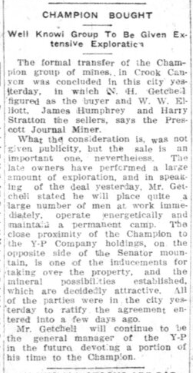
    From the Arizona Republic, August 17th, 1913

    Somehow, any concrete information on Stratton has eluded me, time and time again. There was a famous Harry Isaac Stratton in Colorado in 1902, who was involved in an inheritance controversy which made national news. I highly doubt that this is the same person, as nothing but their names connects them.

    Every possible variation of Harry Stratton’s name fails to bring up a death certificate with a matching time-frame and location.

    Alas, here I am.

    I’ve changed quite a bit since that day. I’ve had an internship and two jobs. I dropped out of high school that December, in the middle of my senior year. I realized that I’m actually a woman. I’ve grown apart from friends, and made new ones. Yet, the Stratton mystery has stayed firmly rooted in a far corner of my mind.

    I think that humans are conditioned to crave neat endings. We want heroes, we want tales of survival and triumph. We want answers.

    Rarely can these be found in reality. Stories are often nothing more than snippets, tiny glimpses into the lives of folks that probably died a century ago.

    I’ve wanted so badly to find something, anything, to shed more light on this. Ever-present is the longing to be the hero in my own story, one of scaling academia to rescue the memory of a poor, lost man.

    There’s an urge to prove that my fixation has meant something. But, the time has come for me to admit defeat to the ravages of history.

    I’ve done all that I can for Harry Stratton.

    I can’t allow myself to spend more time on this project, so I’ve forced myself to put all of this on paper in the hopes that it’ll put the issue at rest in my mind.

    I know it won’t work, but it’s worth a shot.

    -Holly D’Angelo

    In the years since I wrote this zine, I noticed something odd about how folks reacted to it. On four separate occasions I showed a friend or family member, and they immediately started searching for more information on Stratton. 

    At first, I felt somewhat offended by this. I felt that there was some condescension in believing that they would find something in a few minutes of idle googling, that I had somehow overlooked in three years of extensive research. 

    Next, I considered that maybe they were trying to help me. Maybe they had thought of some new angle on the topic, and they thought they could assist me in my search for information. 

    Now, I don’t believe either of these are quite true. 

    I don’t think very often about how I want a reader to feel, when I’m writing something. Usually I’m just creating for the sake of expression, and interpretation is left to whoever wants to take a shot at it. 

    But in this one rare instance, I accidentally made my readers feel exactly how I felt. I believe that I presented this story in such a way, that they felt they had to take on the challenge that it posited.

    In one hand, I think this is a good thing. My goal, after all, was to find any information about the man, and if others can find something I couldn’t, that is definitely a good thing. 

    But on the other hand, the goal of the zine was to relieve myself of the responsibility of carrying Stratton’s story. Having to fact-check people’s findings has been an interesting process, but very rarely do they tread any ground that I have not investigated thoroughly. 

    So real quick, I’m going to list out a few of the red herrings I have stumbled across; 

    – Stratton was not a racecar driver in the mid 20’s. The timeline doesn’t line up.

    – Not a single grave in Arizona lines up with his story, nor do any census details.

    – Ancestry dot com is not a helpful database, in this case.

    – I would say that there is a very slim chance of Stratton being the same as the wealthy heir from Colorado, H. Isaac Stratton. H. I. Did have some investments into a few south AZ mines, but I have no evidence conclusively linking him to Champion, or the Bradshaw area as a whole. So, if you specifically find a missing link in that story, please do let me know.

    In conclusion, if you wish to research into this story, more power to you. If you find anything I didn’t, feel free to share the information.

    But please, do not expect me to start my search again. I only have so many hours on this earth, and many other things I’d like to devote my time to. 

    – Holly D’Angelo
  • Mercuria, Arizona

    A few months back, I made the trip out to the abandoned mercury mine of Mercuria, located between Sunflower and Payson, Arizona.

    This post is mainly to organize some thoughts I had about the experience, as well as some various bits of photography.

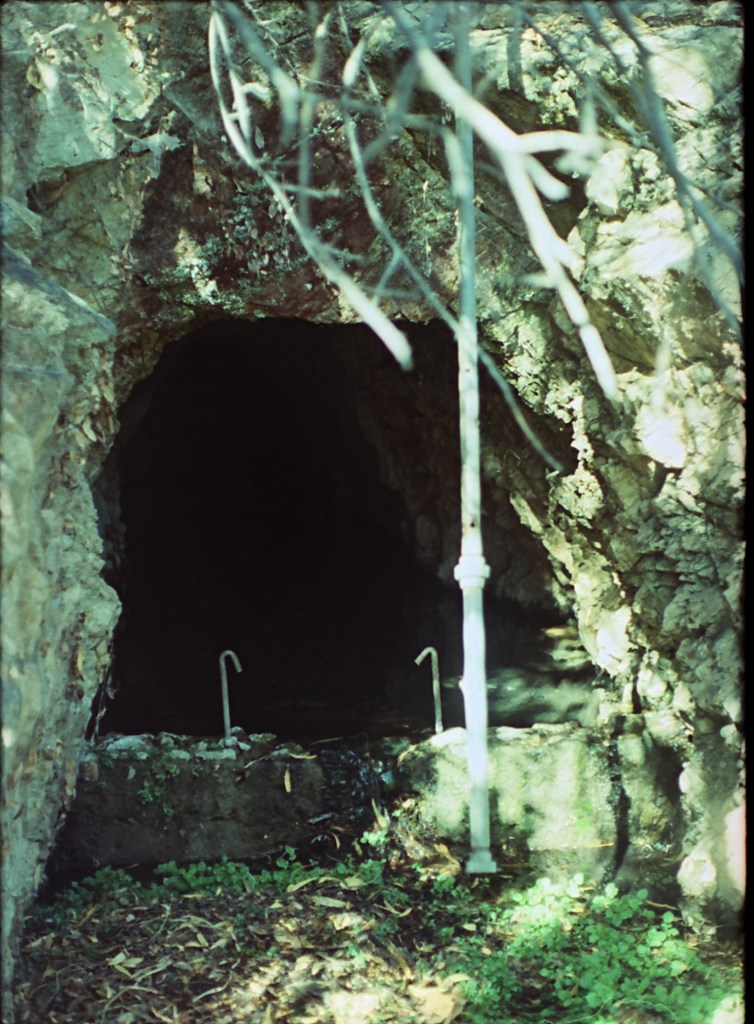
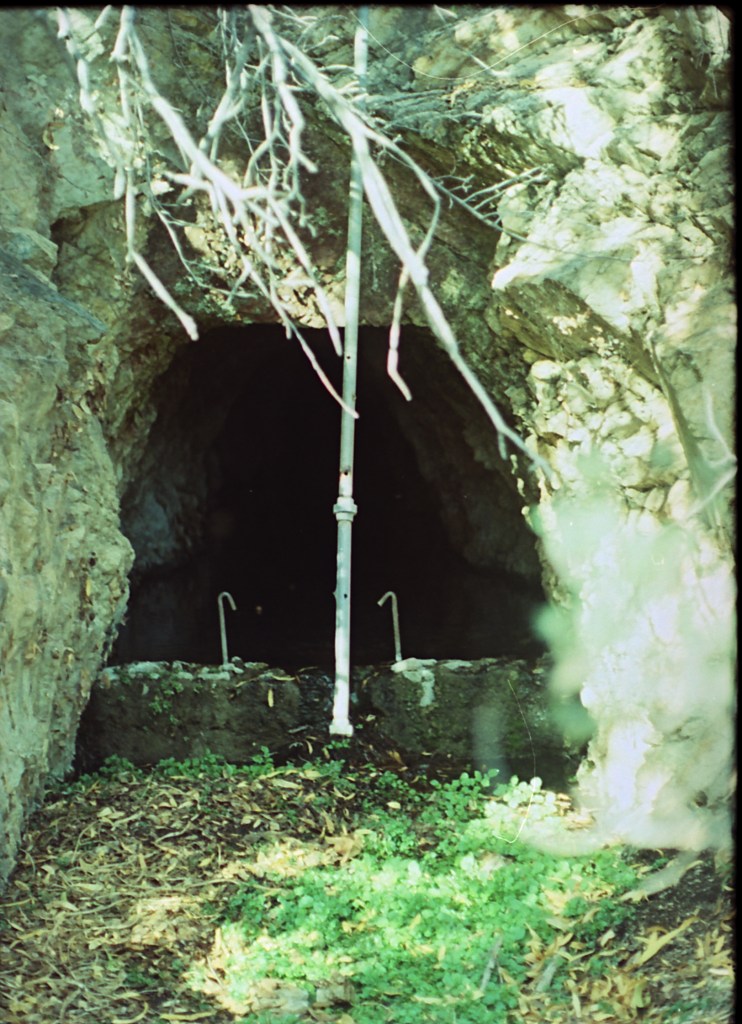
    The main shaft at Mercuria, Shot on Kodak Aerocolor IV, with an Olympus Pen FT.

    Now, typically when I pick a ghost town or abandoned mining camp to explore, I do my due diligence to research the site.

    Yet, beyond a cursory google search to confirm its existence and location, all that I knew about the mine came from a single blog post from 2013.

    (Linked here: https://www.mojaveunderground.com/forum/forum/adventure/mines/1173-mysterious-little-known-arizona-ghost-town-and-mercury )

    Now, there isn’t much in this world that’s more fascinating to me than a “Mysterious, Little-Known Ghost Town”. Yet, after venturing out to the mine, I now doubt that Mercuria is the site described by the post’s author.

    The location of Mercuria, at least of its main ruins, is much too far to have been seen from the highway in the manner described. It’s more likely that the article is talking about “Goswick Camp”, the other possible name that it mentions. I’ll have to go back out there at some point, to see if I can actually locate it.

    But, now to talk about the actual site I ended up visiting.

    Mountains on the way, Shot on Kentmere 400 @800 iso, on a Canon AE-1p.

    From what I’ve found online, the Mercuria mine ran from 1926 to sometime in the mid 60’s. (source: https://www.ironminers.com/mine-history/mercuria-mine/index.htm)

    Other than that, there isn’t much information available. I might do a deeper dive into some newspaper archives soon, and I’ll put my findings into a future post.

    The trip out was a bit of comfortable offroading, for the first 5 miles. It definitely required 4WD in places, but it was manageable.

    The last 0.9 miles, however, were a much rougher, narrower path, and we did it on foot. This mile of hiking became a bit of a trial for me, however, because this trip was also a test for a lineup of three analog cameras;

    • The Canon AE-1P, my daily carry camera until recently,
    • The Olympus Pen FT, a half frame SLR that I had just picked up, (which deserves its own post at some point)
    • The Yashica A, a simple, hardy medium format TLR.

    All of these preformed well, but I’m definitely going to limit myself to two cameras for future excursions. Hauling a bag, two cameras on neck straps, and a jug of water through the mountains was a bit more challenging than I had expected.

    I also believe that juggling the three different formats led to me rushing my shots more than I should’ve, shown in the lack of sharp focus in many of these photos.

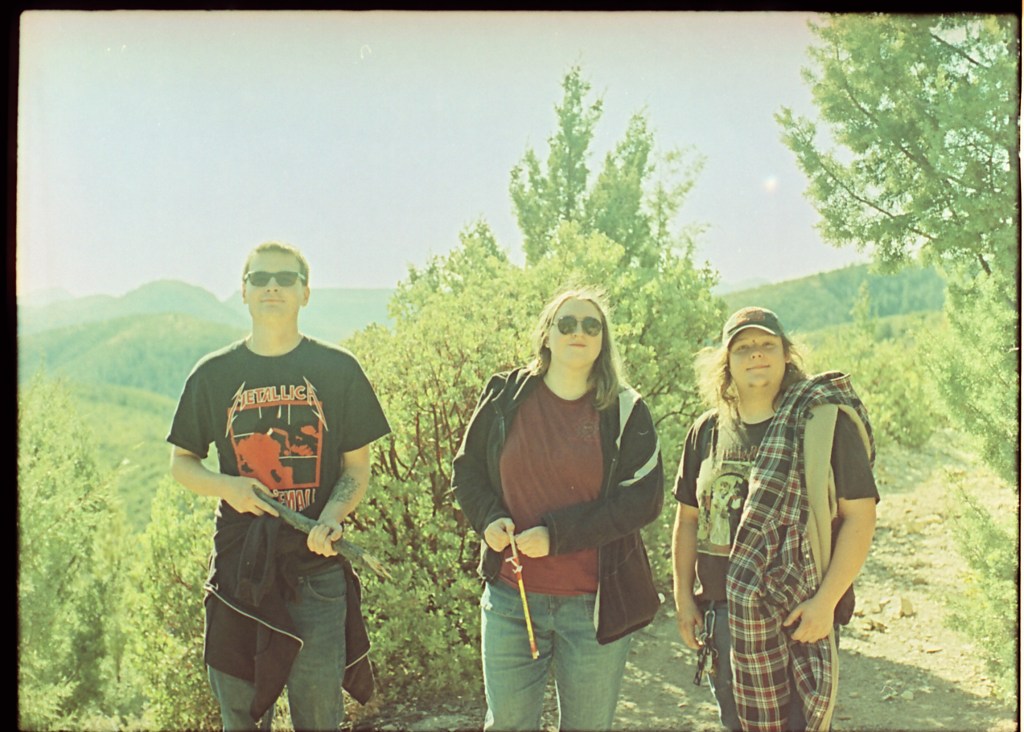
    My adventuring party, standing on the last mile trail. Left to Right; My cousin Chandler, my partner Aria, and my buddy Charles. Pen FT, Kodak Aerocolor IV

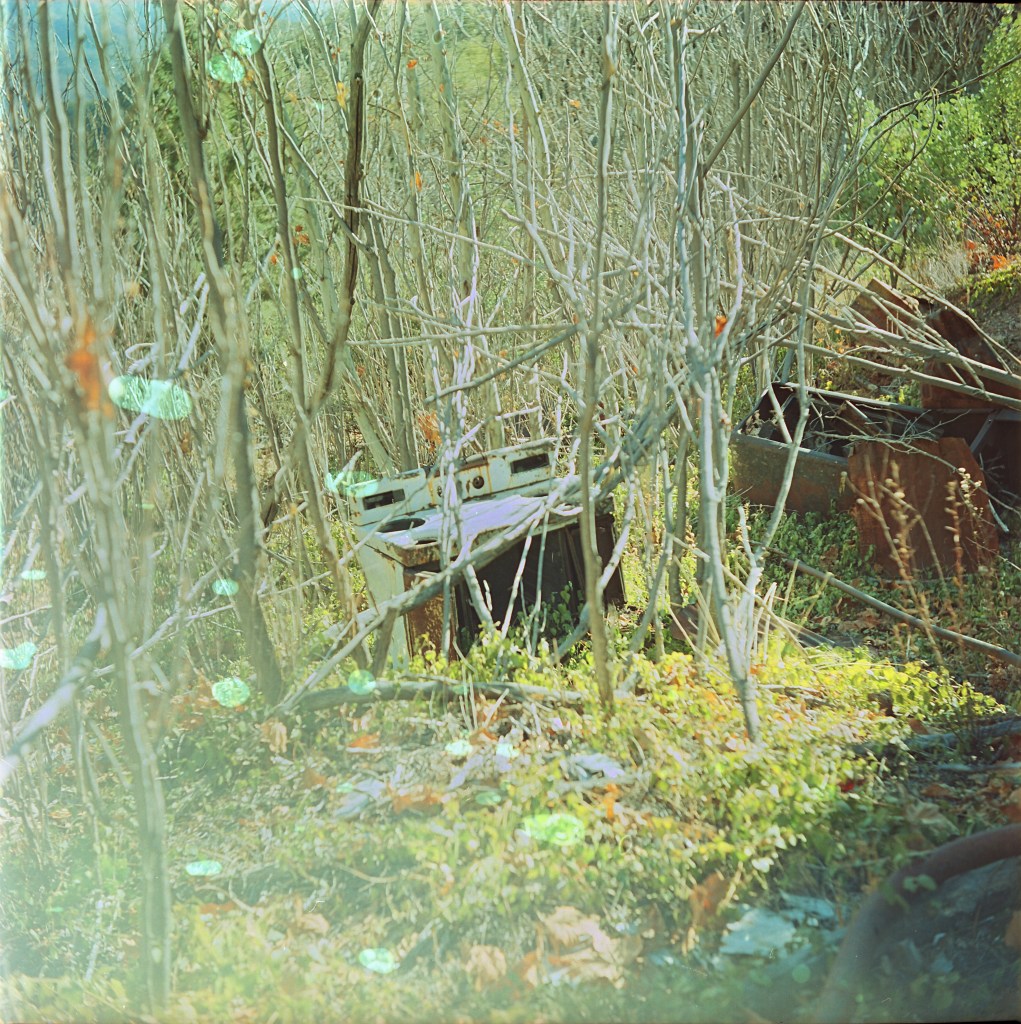
    Once we arrived at the site, we were greeted by the remains of a building, likely some sort of cabin. Very little of the actual structure still stands, now just piles of rusted sheet metal and brick. Pieces of furniture still remain, however. Namely, this rather striking overgrown stove.

    I took photos of this stove with all three cameras, yet this shot from the Yashica A stands out to me. I’ve never seen artifacts like these before, and they give the shot such a unique look. (Kodak Aerocolor IV)

    After exploring the house ruins for a bit, we began to wander around the site. Eventually we found a narrow, overgrown path which led to (what I believe) is the main shaft.

    It has a small, foot tall dam at the front, containing quite a bit of stagnant ground water. I leaned in for a look, but the swarms of mosquitos discouraged further inspection.

    The main shaft, Pen FT, Aerocolor IV

    Down the path from the mine’s opening, we found a few more spots of interest;

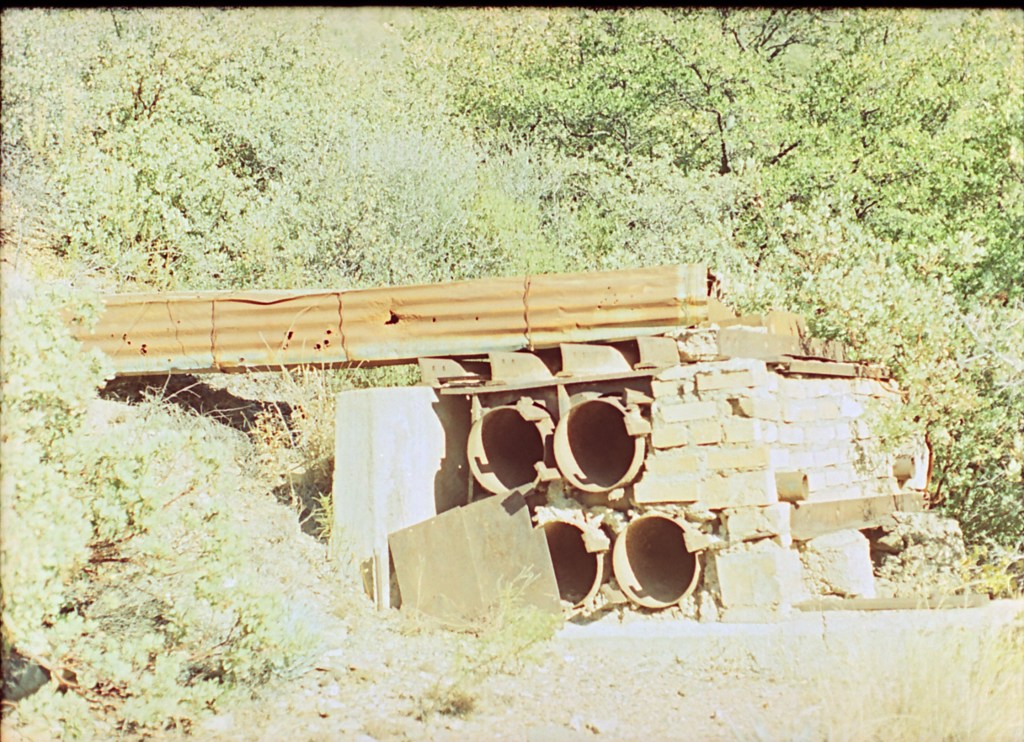
    A very overexposed photo of the ore-processing furnace. Getting used to a new camera is a bit of a process. Pen FT, Aerocolor IV.
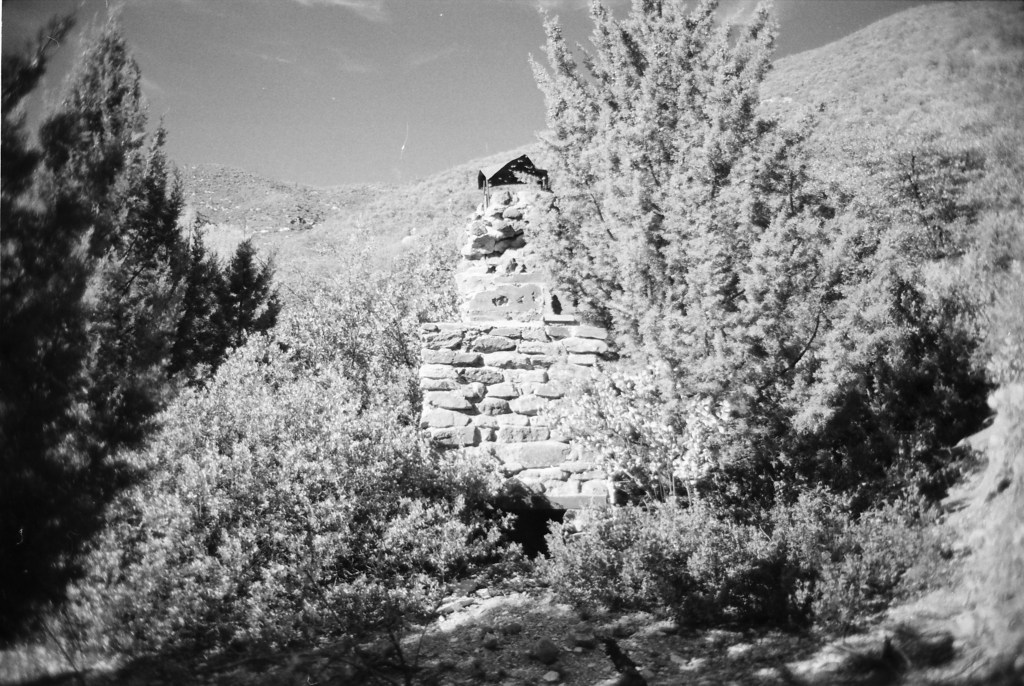
    The remains of a fireplace and a chimney. Interestingly enough, the only brick structure at the site. Canon AE-1P, Kentmere 400.
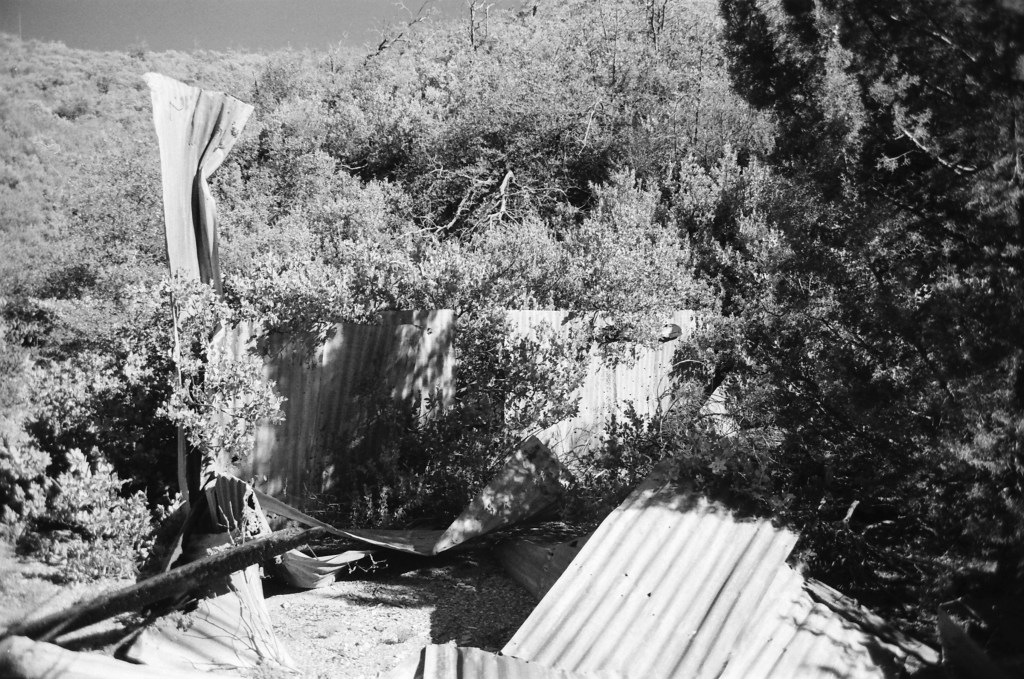
    Sheet metal ruins of another structure, near the processing furnace. Canon AE-1P, Kentmere 400.
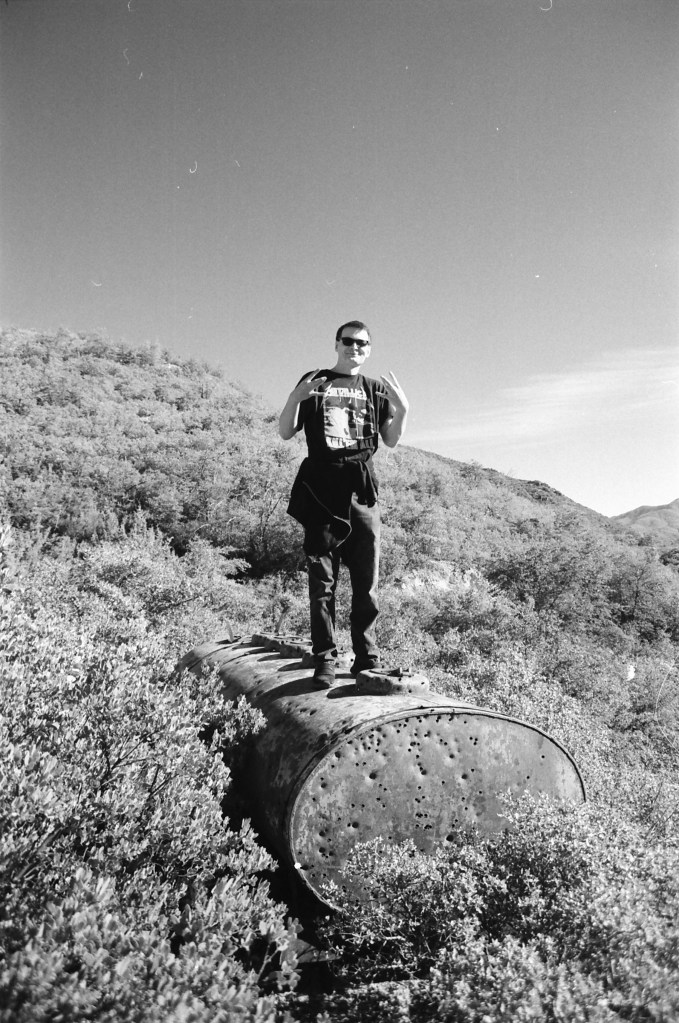
    A large tanker, ft. Chandler. Canon AE-1P, Kentmere 400.

    Overall, the trip was a valuable bit of experience, photography-wise. I’d say that I averaged 8-14 good photos per 35mm roll.

    It was also an interesting challenge to the “philosophy” surrounding my photography.

    (I might get a bit pretentious here, but calling an analog photographer pretentious is a bit like calling water wet. It comes with the territory.)

    There seem to be two mindsets that I can be in when I’m taking photos; Art and Documenting.

    If I’m trying to make “art”, the primary concern is trying to take something that looks good. Aesthetics are the most important factor, even if that means I’m not necessarily portraying the subject accurately.

    Whereas, if I’m trying to document something, ideally the aesthetics are pleasing, but the goal is to create a good representation of the photo’s subject. This might mean accepting a flatter image in order to bring out more details, whereas I prefer very high contrast when I’m shooting for “art”.

    Ideally, these two mindsets might merge as I’m shooting. I want to make art that represents my subject as I see it, without sacrificing the visual quality of the image. I feel like this isn’t a unique goal to my photography, but it is one that’s taken me a while to fully realize.

    I believe that this excursion was a decent attempt at it, but the results still leave something to be desired. for most of these shots, I’ve had to resist putting asterisks in their captions, describing what I could have done better to frame, focus, or meter for them.

    But, even if it’s a learning experience, I also need to let my work speak for itself.

    – H. A. D’Angelo

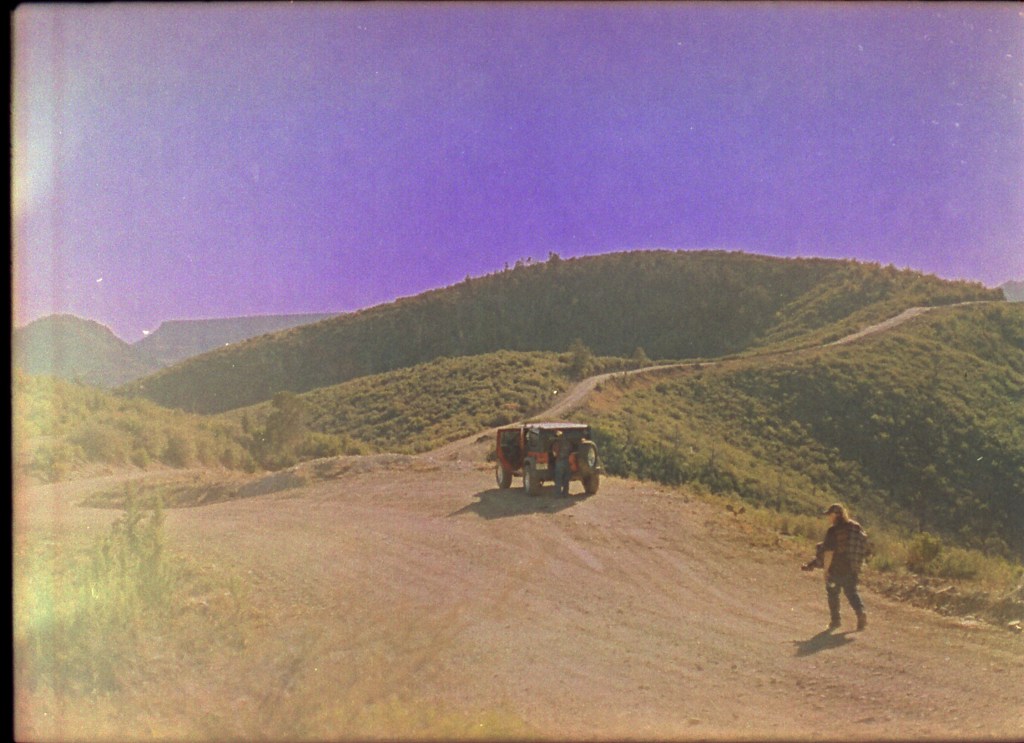
    Walking back to the jeep. Pen FT, Aerocolor IV. This photo came out pretty odd, and my scanner made it weirder. But, I like it.

  • On the Collapse of the World Around Me, and the Rebellion of Holding On. 

    My name is Holly Agatha D’Angelo.

    I am a 23 year old transgender woman from Phoenix, Arizona.

    I’m a lesbian, and my gender presentation is a bit more butch than you’d expect from your stereotypical transfem.

    I’m around three and a half years into my transition, yet I rarely wear dresses outside of my work uniform and special occasions. I can’t remember the last time I wore makeup. My legs are hairy, but I try to keep my forearms smooth.

    My morning routine consists of me shaving a face full of stubborn hairs, tying my waist-length hair into a rough bun, and putting on a t-shirt and jeans. 

    When you meet me, my speaking voice is typically the first giveaway. I raise it slightly, but beyond one or two attempts, I’ve never committed to fully changing it. It’s hard to articulate exactly how voice training makes me feel, but the closest I’ve gotten is “existentially bad”. 

    Obviously, as a trans person, it would be easier if I leaned into the stereotypes. If I had a higher pitched voice, I wouldn’t be scared to speak when I’m in a public restroom. If I dressed more feminine, I might not be misgendered by 4 out of every 5 strangers I meet. If I “passed”, I might not be constantly afraid. 

    Alternatively, there’s the opposite. 

    Detransition. I could give all of this up. I could admit defeat to a world of hostility. Go back to my deadname, stop shaving, pretend that all of this never happened. I’d want to kill myself, but I’d be “safe” again. A straight cisgender man, in a world that caters to me. 

    Neither of these options are me. I’m not a man, nor am I the peak of femininity. Pretending to be either would be a betrayal of myself, even if it would be easier.

    If you’re reading this, you know what the world is like right now. 

    The U.S. government has declared war on transgenderism as a concept. We’ve been scrubbed from official federal histories. Our access to HRT is under constant attack. I could go on, but it wouldn’t be good for either of us. I already have panic attacks when I read the news, relaying it is a whole other matter.

    In this climate, it’s become evident that the very action of holding onto my identity is now an act of rebellion. I may not be able to effect change in the wider sense, but I am able to do this; 

    I will be my authentic, queer self, and I will take joy in it. I will grieve our losses, and celebrate our victories. I will make art, form new friendships, and keep my loved ones close. 

    I will enjoy my life, to spite those who want to see me suffer. 

    Death Before Detransition, 

    Holly D’Angelo.